Update on recent activity-Depression and the Church Conference

Update on recent activity-Depression and the Church Conference

Thank you for your interest.  I am back with news of good  things happening with the Church’s integration of mental health issues.

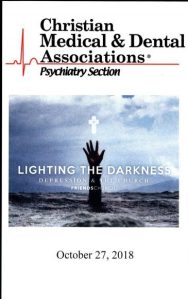
Here is the recent conference on depression I worked on from October 2018. It was sponsored by Friends Church Yorba LInda, and the Christian Medical and Dental Association’s Psychiatry Section.

Here is the conference announcement introducing the day:

Lighting the Darkness – Depression and the Church

Friends Church, Yorba Linda, CA

Depression and/or sadness has become an epidemic in our society affecting large segments of our population, including adults, children and adolescents. It is often a medical condition treatable through a combination of support systems, counseling and medicine.  Unfortunately, in the Christian community, it is often viewed as a spiritual issue (not having enough faith, or not having the balance in our Christian life that God intended).  In fact, feelings of depression and/or sadness do not mean we are doing something “wrong” in the Christian life.  Because the world is not as it should be, due to the fall, a certain degree of sadness will always mark the Christian life.  We read in Scripture about Christ weeping and being sad. It is a normal part of the Christian experience.  In addition, because our bodies are not as they should be, the various parts of our bodies – including our mind – can be affected in ways that have nothing to do with us doing things “wrong”.   Christ in John 10:10 says “I have come that they may have life, and have it to the full.” This would include both mental and physical healing and the use of medical resources where appropriate.

This conference brings together local Church leaders, distinguished psychiatrists and mental health professionals of the Christian faith, to provide education, spiritual direction and reduce the stigma surrounding those who suffer or support those suffering from the destructive illness of depression.  Friends Church, Yorba Linda, represents the Friends denomination with a legacy of faith in Christ and social action, including a legacy of advocacy for healing and reducing the stigma of mental illness.  The Christian Medical and Dental Association is a nationwide organization of over 19,000 Christian health care professionals, that provides resources, networking opportunities, education and a public voice for Christian healthcare students and professionals.  The Psychiatry Section of CMDA is comprised of psychiatrists with Christian faith who strive to promote fellowship and provide community to support and encourage Christian physicians in the practice of psychiatry, as they explore the relationship between their faith and professional practice. They also promote within the church the knowledge and understanding of valid psychiatric approaches to mental health and healing, consistent with Christ’s redemptive love.

Here is the link to view the conference.  Many were blessed and found it helpful.

https://cmda.org/events/2018-psychiatry-section-depression-conference/

 

Mental Illness and Spiritual Crisis

The shock of being diagnosed with cancer is similar to the shock of being diagnosed with a mental illness.

When this happens, even a person of strong Christian faith can have a crisis of faith.  Experiencing an illness which causes self-destructive actions, psychotic perceptions or impulsive, bad choices can change life forever, and it is in the recovery from illness that faith and identity reforge life to a different level. This new level is hopefully more meaningful, leading to intimacy with God and a world that is more consistent with the tenets of the faith. This is not a simple path, as psychiatric and psychological treatment is not easy.  Recovery is also complicated by unexpected responses from distant as well as intimate life relationships, including those in the family and the church. These responses can either encourage recovery or divert healing, but they can direct the course for the rest of life.

This life experience has been described through time in different contexts and cultures. “Trials,” “sufferings,” “tests,” and “dark night of the soul” can be some of the ways believers have identified their experiences of mental illness.  The terms of psychiatry, and the successful treatments that result from medicine, describe these experiences in a scientific context that supports healing, but this medical science does not attend to spiritual struggles that take place during this “dark night.”  It is no wonder why mental illnesses comprise a majority of the top causes of disability worldwide.  Emotional pain and loss of function are more devastating when spiritual confusion and loss of life meaning is added to the struggle.

Questions of “why God,” “why me,” and “how can you let me suffer ” are just some of the painful cries that circle in the mind of a Christian while in acute mental illness. These questions are asked even by older believers with mature character and deeper spiritual understanding, including pastors and church leaders. This is not different from Job’s cries to God during his sufferings. The Apostle Paul’s “thorn” is an example of these spiritual struggles with a frustrated request for healing despite a victorious Christian life.

Relief from pain and restoration from illness are the hope of medical treatment.  When the relief from pain or restoration to former function is incomplete, the veil of “normal life” is lifted and the brokenness of life on earth is revealed. How then can God still be sovereign and loving? How can suffering be transformed to “delight” as described by Paul?

When one suffers from acute mental illness, obtaining good mental health care is crucial for healing and returning to a functional life. For the believer, there is an accompanying deep search for spiritual meaning in the suffering. This requires holding on to our belief of a sovereign God, and experiencing His love above all else despite the pain.  Job’s ability to question his sufferings and not sin, and Paul’s ability to count his thorn as a delight are models for our response and spiritual direction.  Despite severe illness, as followers of Jesus, we can believe in a higher purpose to our suffering.  We hold in faith that God is more powerful, knowledgeable and more loving than our experience of pain and loss of a “normal” life.  With meaning, our suffering and disability can be overcome.  The “dark night” we experience can lead to a transformation of our brokenness, and as with Job and Paul, we can surrender to a life in deeper communion, empowered by Him.

Emotions

Emotions have been devalued and mistrusted in the Evangelical world. After a thirty year career of treating Christians with mental illnesses, I have seen that emotions are crucial to life. Even as Jeremiah describes the heart as deceitful, emotions warn us of danger, connect us to joy, and direct us to love. They teach us what we like and what we don’t like, defining our identity and our God-given specialness, drawing us to relationship. Feelings are the language of the Spirit, and are a key to our spiritual life. This is why illnesses that disrupt emotions are so disabling. Mental illnesses are destructive emotionally, relationally and spiritually. When the Church and its believers can understand and embrace their own emotions, they will be released to grow in themselves, with others, and with God.